THREE STORIES
Stories Behind the Machines
What really tells you the value of a used pump truck is the work it has done, the people who chose it, and the people who have run it. Here are three stories.
 First Story
Two Days, Two Nights — On an Island, Building a Bridge to the Sea
 Liuheng Bridge, Zhoushan, Zhejiang
 May 2024 – present
 PM:
Xie Jichao
PM:
Xie Jichao
 Operators:
Zhang Xingming, Zhou Jing
Operators:
Zhang Xingming, Zhou Jing
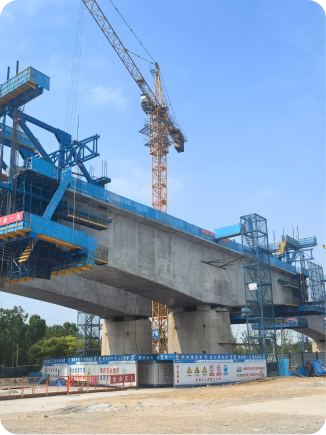
In May 2024, our fleet took on the Liuheng Bridge project in Zhoushan, Zhejiang — a cross-sea bridge with the work site sitting on Fodu Island.
Projects like this aren't really an engineering test. They're a test of life. There isn't much on the island. The sea wind is in your face all day. Xie Jichao led the deployment with two operators, Zhang Xingming and Zhou Jing. Since May 2024, apart from one trip home for Spring Festival, they have lived on that island. For almost two years, the job site and the dorm have been nearly the entire world they've seen.
The hardest stretch was a single continuous pour. Two full days and two nights, with no stop. The operators rotated for meals. The pump truck didn't rest once.
Across the entire service period, our truck never once held up the project because of an equipment problem. That sentence sounds plain. But anyone who has worked a coastal site knows exactly what it means — high humidity, salt in the air, continuous duty cycles. A failure in the hydraulics, the electronics, or the chassis, and the whole site stops.
"You guys are the kind of company we can hand a project like this to and stop worrying about it."
As of today, that truck is still on the island. When its work there is done, I hope its next owner knows not only the model and hours, but the job site it came from.
Second Story
Holding the Line at 4,000 Meters — The Truck Didn't Quit, and Neither Did We
Sichuan-Tibet Railway, Tibet section
June 2025 – present
 PM:
Xie Jichao
PM:
Xie Jichao
 Operators:
Wang Wenyi, He Yanqing
Operators:
Wang Wenyi, He Yanqing
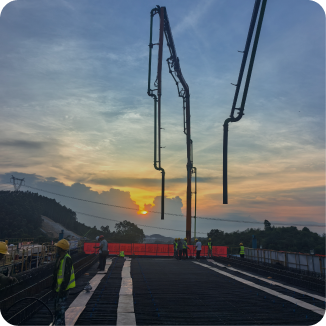
The Sichuan-Tibet Railway is one of the hardest engineering projects in China today. High altitude. Brutal geology. People give out before equipment does.
In June 2025, we sent two trucks into Tibet. Our operators on those trucks were Wang Wenyi and He Yanqing.
Wang Wenyi is one of our veterans — he has been driving pump trucks for over a decade. This was his first time on the plateau. Within a few days of arrival, severe altitude sickness put him in the hospital. He stayed there for a full week.
By any reasonable standard, that's the moment you call him back and rotate someone in. Nobody would have blamed him. But the day after he got out of the hospital, he went back to the site and back behind the wheel. Over the course of that year, he later told us, he lost 30 jin — about 15 kilos.
"It would have been easy to leave. But the project is hard no matter who goes up there. If I leave, the next guy faces the same thing. If I hold the line, at least the company knows we can take this kind of work."
WW
Wang Wenyi
Operator, 10+ years
During that period, we did not record any major downtime caused by the core pumping or hydraulic systems. On a plateau job site, that kind of steadiness matters.
That is the point of this story. You are not only buying a machine. You are also trusting the judgment of the people who selected it, repaired it, and kept it working when the job site was difficult.
Third Story
Three People. One Job for Over a Decade — Picking Trucks.
 Xie Jichao · Zhang Qingyan · Zhu Yulong
 10+ years each with the company
Not a single used truck in our fleet was bought from a used-equipment broker.
Every one of them was personally chosen by these three people: Xie Jichao, Zhang Qingyan, and Zhu Yulong. All three have been with us for over ten years. They are the people in this company who understand trucks the best — and they are also the people in this company who actually run trucks the most.
Those two facts, sitting side by side, are the single biggest difference between us and the operators you'll find selling 'used pump trucks' online.
Most of the people selling used pump trucks are brokers. A broker's logic is simple: buy low, sell high, pocket the spread. Whether the truck will survive its next project on a plateau is not really their concern. Once it's sold, it's no longer their problem.
The three people who pick our trucks operate under a completely different incentive. Every truck they bring in goes straight to one of our own job sites. They are the ones who'll have to repair it. They are the ones who'll have to service it. They are the first ones called out when something fails.
Under the pressure of "the truck I picked is the truck I have to live with":
1
They look for signs that paint cannot hide: boom wear, chassis stress, hydraulic leaks, outrigger condition, and how the truck feels under load.
2
They don't just read the operating-hour meter. They cross-check the maintenance records — because in this industry, plenty of those records are written after the fact.
3
They don't just run a test pour. They trace the previous owner's actual usage habits — did this truck run on dirty-aggregate sites? Was it routinely overloaded?
4
They don't just look at the price. They factor in what it will cost to bring the truck back into proper condition once they get it home.
5
Over the years, the three of them have walked away from far more trucks than they have brought back.
So every used truck you see on this site is a truck they chose first, then ran themselves, and only then decided to sell.
The whole thing comes down to one sentence. The people who sell trucks and the people who run trucks are two different kinds of people. The trucks in our hands were picked by people who run trucks.


